

Driveway Extension
in Port Orchard, Washington
Almost nobody widens a driveway because they woke up wanting a wider driveway. They do it because backing out has become a three point turn, because two vehicles cannot pass, because the edges have crept in year after year, or because a trailer now lives on the property and there is nowhere sensible to put it.
We handle driveway extensions and widening across Port Orchard, Kitsap County, Mason County and Gig Harbor. The work is less about adding rock and more about making the new part behave like it was always there.
★★★★★
"Doug did a great job grading, re-rocking, and compacting our rather steep driveway that had become very worn down, rutted, and rough to drive on. It's now back to its original width, smooth to drive on, and is holding up well through rain and snow. I'm also very pleased that the water is draining down the side of the driveway, away from the house, as Doug designed it to do."
Cynthia Wooten, Google Review
★★★★★
"Straight Up Excavation did an amazing job grading our long, winding dirt driveway. They went above and beyond, working within our budget and tight timeline, and exceeded all my expectations. Easy to work with, professional, and communicative."
Ted Lockwood, Google Review
★★★★★
"Doug was great to work with and addressed all of our concerns for our road grading project of our small one lane driveway. He even came back to do some clean out of our ditches after one of my neighbors expressed some concerns."
Nick and Athena Docter, Google Review
When a Driveway Has Quietly Outgrown Its Width
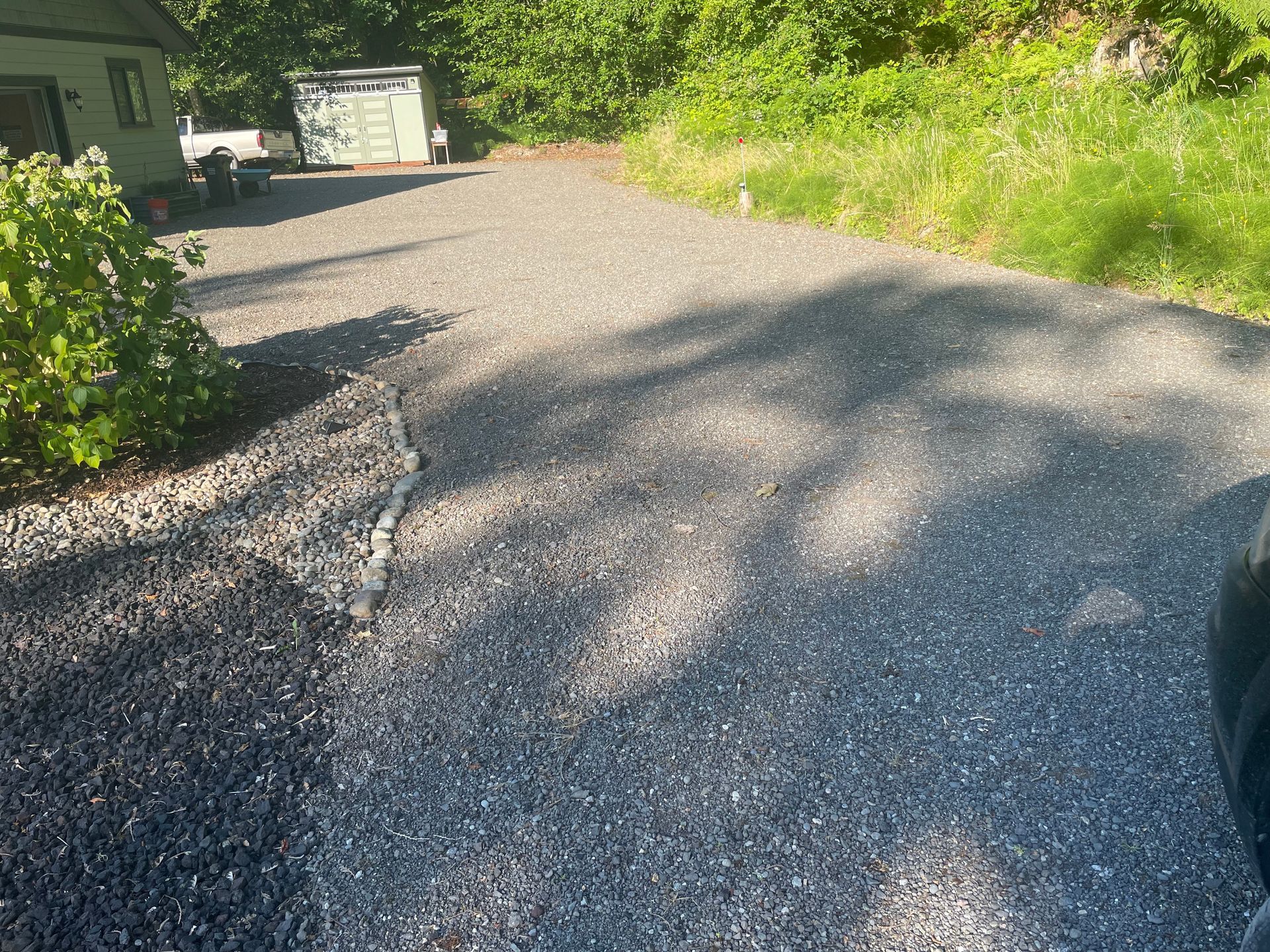
Driveways narrow on their own. Every season, vegetation pushes in from the shoulders, rain moves material off the edges, and the drivable strip shrinks by an inch or two that nobody notices. Ten years of that and a driveway built at 14 feet is running at 10.
A few practical measures are worth knowing. A single vehicle wants around 10 to 12 feet of firm running surface. Two vehicles passing comfortably needs closer to 20. A truck with a trailer needs more width at the corners than on the straight, because the trailer cuts inside the tow vehicle's line every time. And a turnaround that works for a sedan can be useless for a delivery truck or a fire apparatus, which is worth checking if your property sits at the end of a long private approach.
Is your driveway actually too narrow, or has it just lost the width it was built with?
Those are different jobs. One adds ground. The other recovers it. We will tell you which one you are looking at when we walk it.
Matching New Work to the Driveway You Already Have
This is where widening jobs go wrong, and it happens long after the crew leaves.
Why does a widening that looked perfect in September show a ridge down the middle by March?
A new strip laid alongside an old driveway carries a seam down its whole length. If the new section is built shallower than the original, it settles at a different rate, and within a couple of winters there is a visible ridge or trough down the join. Water then finds that line and runs along it, which accelerates everything.
So we build the extension to match or exceed the depth of what is already there. That means excavating the new strip properly rather than laying material on top of sod, compacting it in layers, and blending the surface across the join instead of butting it up against the old edge.
We work with all three surfaces. On a gravel driveway the widening blends in and the whole run can be regraded together, which is the tidiest outcome. On asphalt or concrete, an extension is more visible by nature, so the honest conversation is about whether you want a matched hard surface strip, a rocked shoulder, or the existing surface removed and the whole approach redone. There is more on material choice in our guide to
the best material for making a driveway wider.
How We Widen a Driveway
1. Walk it and mark it.
We stake the new edge so you can see the width before anything is cut, and check what is in the way. Trees, utilities, a bank, a ditch, a septic component.
2. Clear the shoulder.
Vegetation, stumps and roots come out. Roots left in place rot and leave voids under the new surface, so
stump grinding or removal often comes first.
3. Cut and shape the ground.
Widening into a slope means cutting back into it and dealing with the material that comes out. Widening on the downhill side may mean building the shoulder up and holding it.
4. Build the new section
in compacted lifts
to the depth of the existing driveway.
5. Regrade the whole
width together
so the crown runs across the finished driveway and not just the old half.
6. Sort out
the water.
A wider driveway sheds more water from a wider surface, and the ditch or shoulder that handled the old width now has more to carry.
Step six catches people out. Widening changes drainage whether you plan for it or not, so we would rather plan for it. On several jobs that has meant cleaning out ditch lines or resetting a culvert as part of the work, which sits alongside our
drainage solutions and
land grading.
Turnarounds, Pull Outs and Parking Space
Not every width problem is solved by making the whole driveway wider. Often the cheaper and better answer is a targeted addition.
A turnaround at the top means no more reversing 200 feet down a curved approach in the dark. A pull out halfway along a single lane driveway lets two vehicles pass without either one backing up. A parking pad off to one side keeps the trailer, the boat or the second car off the driving surface entirely, which stops the edges from breaking down where people park on them.
These are usually a day or two of work and they solve the actual daily irritation. When we quote a widening we will tell you if one of these would do the job for less.
Every crew that turns up is
licensed and insured, and the work carries
a satisfaction guarantee.
Permits, Setbacks and the Road Edge
Most residential widening on your own property does not need a permit. The exceptions are worth knowing about before you start.
Changing where a driveway meets a county road, or altering a culvert at the road edge, usually involves the county. Work near a critical area, a steep slope, a wetland buffer or a shoreline may trigger review. Larger amounts of grading or fill can cross a threshold on their own. And if you are on a private road there may be an agreement between owners covering what can be changed.
We check the current requirements for your specific site rather than assuming, and our Kitsap County excavation permits guide explains what homeowners here typically run into. If a permit is needed, you will hear that from us at quote stage.
Frequently Asked Questions
Let's Look at Your Driveway
We are family-owned and based in Port Orchard. If what you actually need is a brand new approach rather than more width on an existing one,
that is covered on our driveway installation page.
Tired of reversing the full length of a narrow driveway?
Call Straight Up Excavation and Drainage at 360-337-9051 for a driveway extension estimate in Port Orchard.